Over the years, Excel makes several types of mathematical problems simpler, among them calculating column volume in geometry. While putting numbers into a calculator can calculate the volume of a column, Excel can provide to enter multiple dimensions for the geometry and can calculate each of the volumes at a glance. In this article, you will learn to calculate column volume in Excel in 3 quick steps.
How to Calculate Column Volume in Excel: Easy Steps
📌 Step 1: Set Column Dimensions
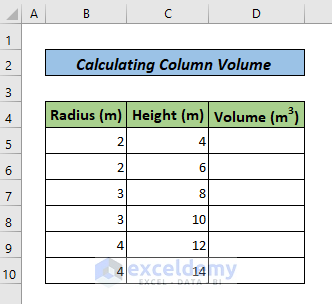
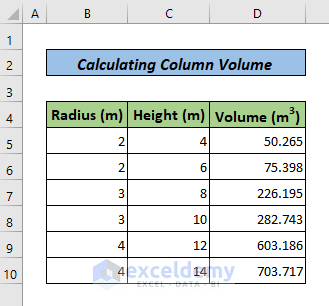
Let’s first introduce our dataset. There are 3 columns that contain Radius, Height, and Volume in m, m, and m3 units respectively. 6 samples of columns of different dimensions are taken.
📌 Step 2: Apply Formula to Calculate Column Volume
Generic Formula for Column Volume
=π×r2×h
Here,
- The PI function returns the value of π (3.14159265358979), accurate to 15 digits,
- r is the radius of the column,
- h is the height of the column.
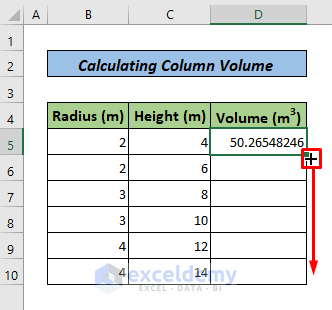
- Now, we will apply this formula to our dataset. To do this, select cell D5, and type the following formula. Press ENTER.
=PI()*B5^2*C5
- Now, drag the Fill Handle to the remaining cells as shown in the following image.
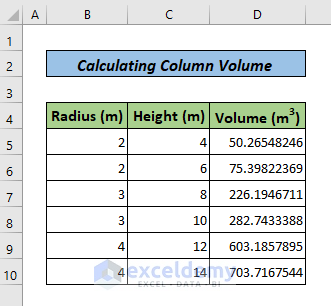
Finally, here are the calculated volumes of all the column samples.
📌 Step 3: Customize the Results in a Proper Format
At this stage, you can customize your result in a proper format. For this-
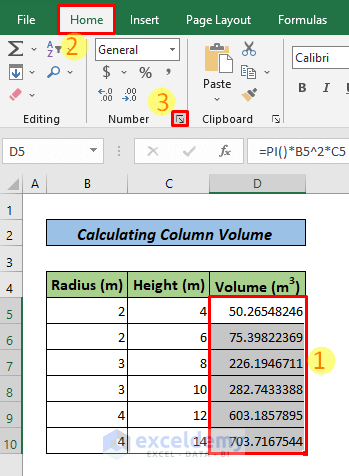
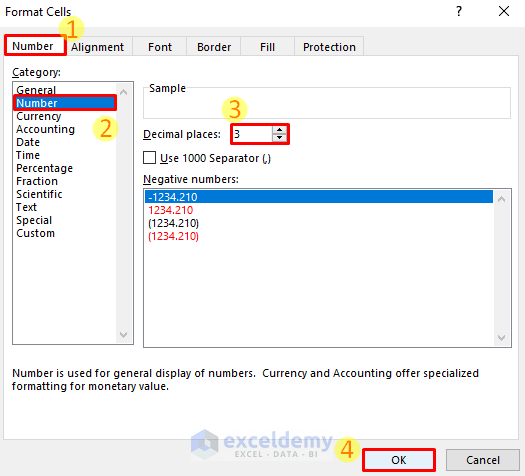
- You need to select all the calculated volumes, then go to the Home tab >> Number group >> Format Cells icon. A Format Cells dialog box will appear.
- Now, under the Number section, select Number from the Category list.
- Then, in the Decimal Places box, choose or type the number to which decimal places you want your column volumes to be. In this example, we choose 3 decimal places.
Finally, here are the formatted computed column volumes.
Download Practice Workbook
You can download the following practice workbook that we have used to prepare this article
Conclusion
In this tutorial, I have discussed 3 quick steps to calculate column volume in Excel. I hope you found this article helpful. Please, drop comments, suggestions, or queries if you have any in the comment section below.
<< Go Back to Area and Volume | Formula List | Learn Excel
Get FREE Advanced Excel Exercises with Solutions!