

Method 1 – Use Excel TEXT Function to Convert Minutes to Hours and Minutes
Steps:
- In the C5 cell insert the following formula.
=TEXT(B5/(24*60),"[hh]:mm")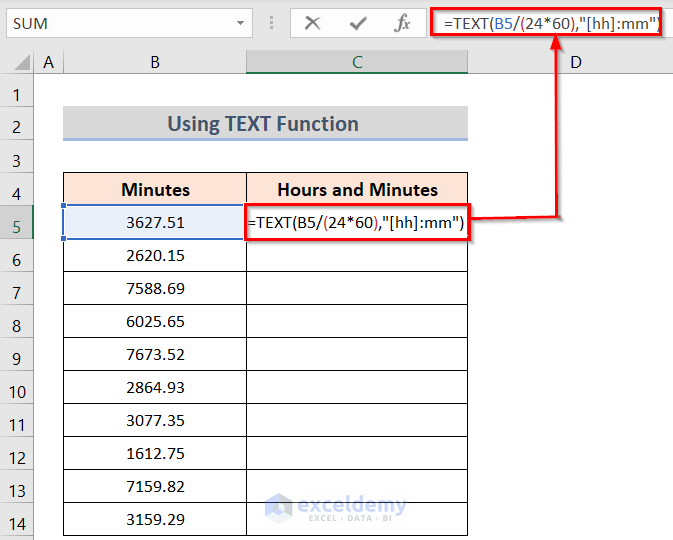
- After pressing the Enter button, you will get the result for the cell and then use the Fill Handle to apply the formula to all the desired cells.
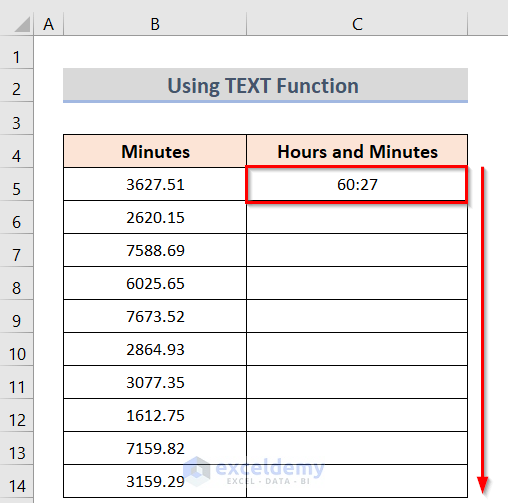
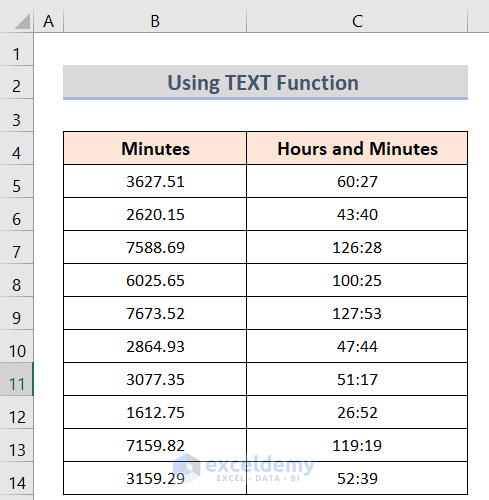
- You will get the desired result.
Method 2 – Use of CONVERT Function
Steps:
- In the C5 cell insert the following formula.
=CONVERT(B5,"mn","hr")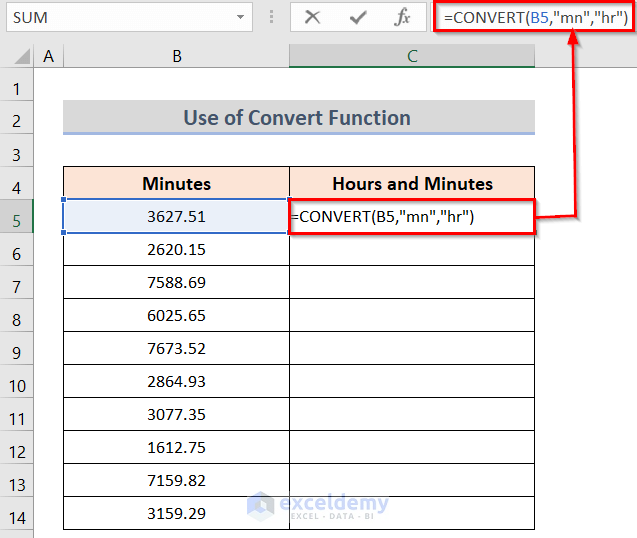
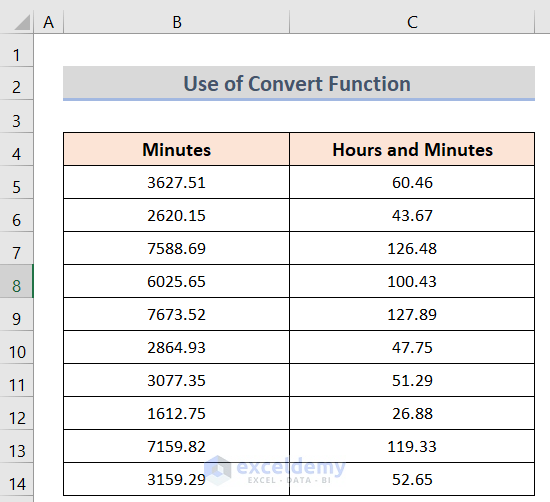
- If you press the Enter button, you will get the result for the cell and then use the Fill Handle to apply the formula to all the desired cells.
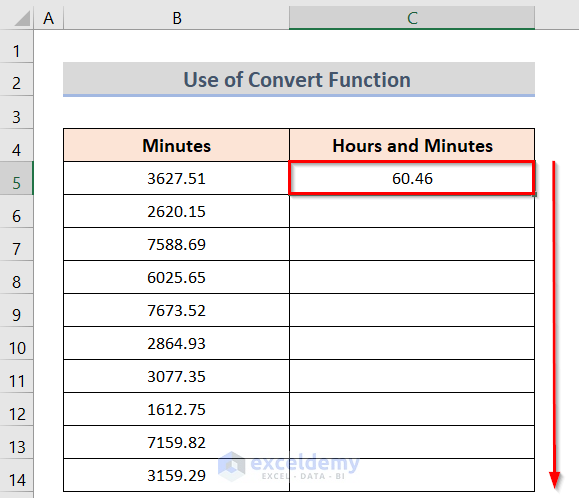
- You will get the desired result.
Method 3 – Combine QUOTIENT and INT Functions to Get Hours and Minutes from Minutes
Steps:
- In the C5 cell insert the following formula.
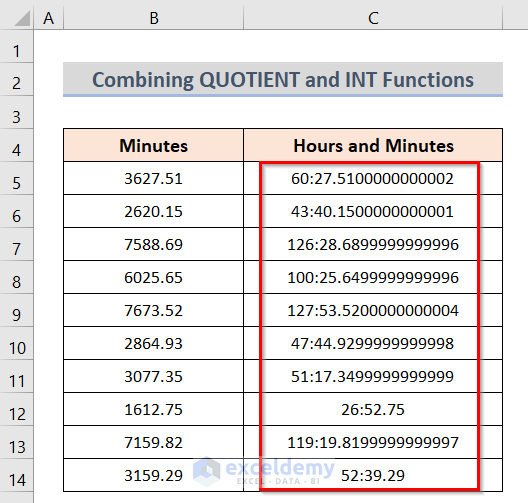
=QUOTIENT(B5,60)&":"&IF(LEN(MOD(B5,60))=1,0,"")&MOD(B5,60)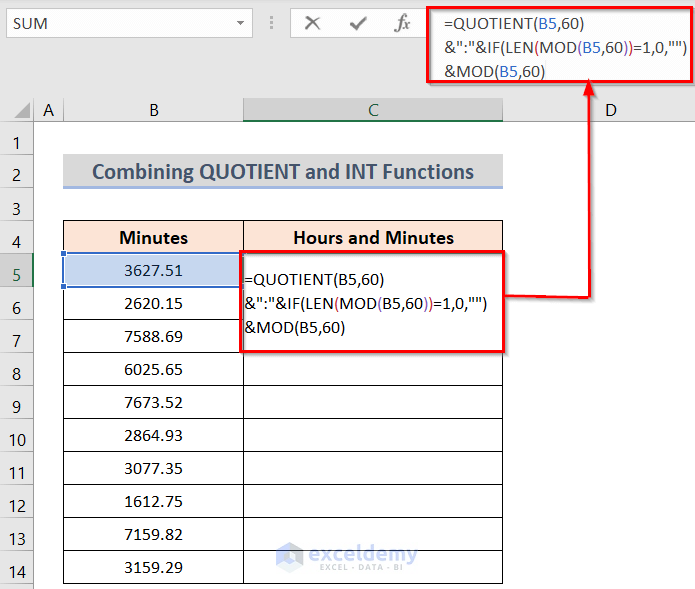
- Press the Enter button, and you will get the result for the cell, and use the Fill Handle to apply the formula to all the desired cells.
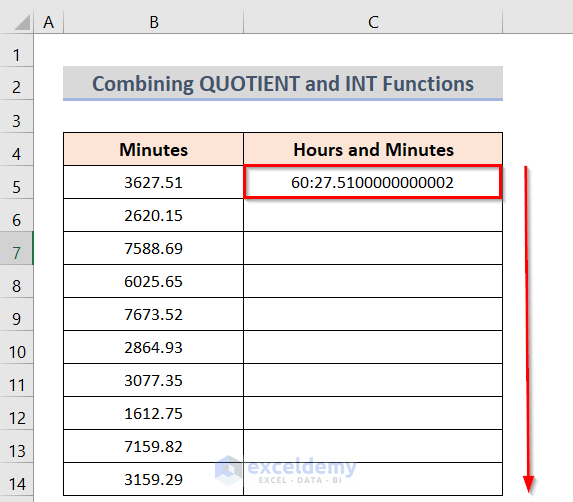
- You will get the desired result.
How Does the Formula Work?
Method 4 – Manually Convert to Minutes and Hours from Minutes in Excel
Steps:
- In the C5 cell insert the following formula.
=B5/60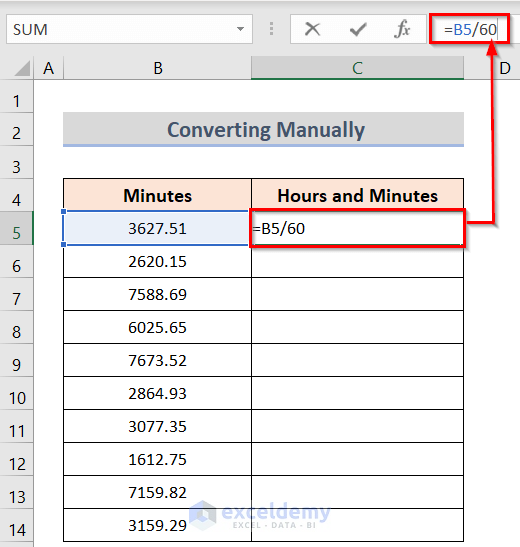
- Press the Enter button, you will get the result for the cell and then use the Fill Handle to apply the formula to all the desired cells.
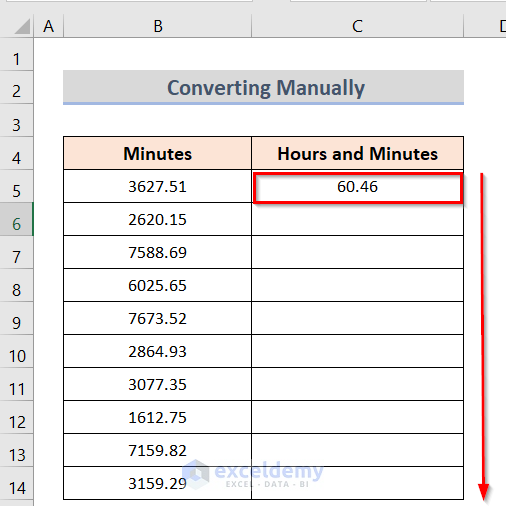
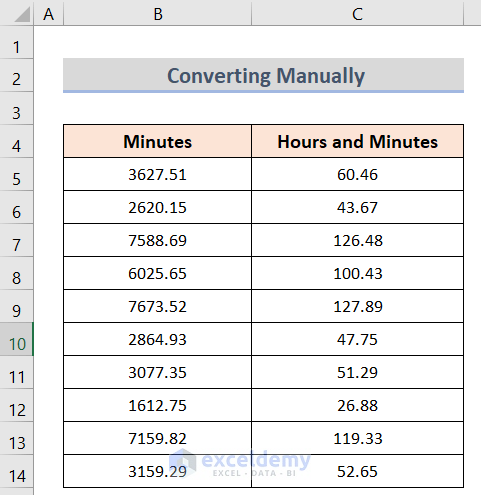
- You will get the desired result.
Method 5 – Use of Custom Formatting for Conversion Between Minutes and Hours
Steps:
- In the C5 cell insert the following formula.
=B5/(24*60)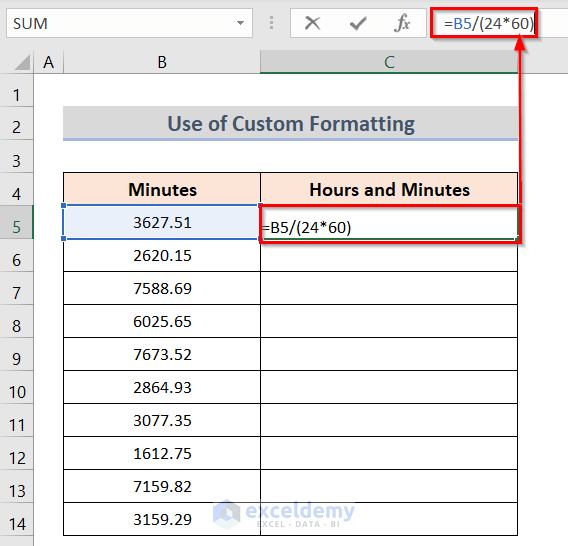
- Press the Enter button; you will get the result for the cell. Use the Fill Handle to apply the formula to all the desired cells.
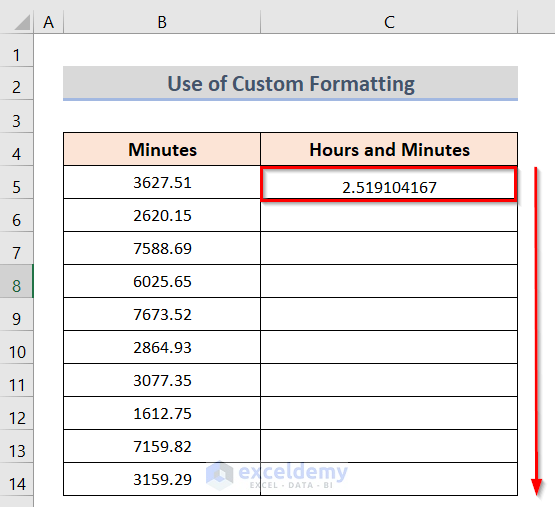
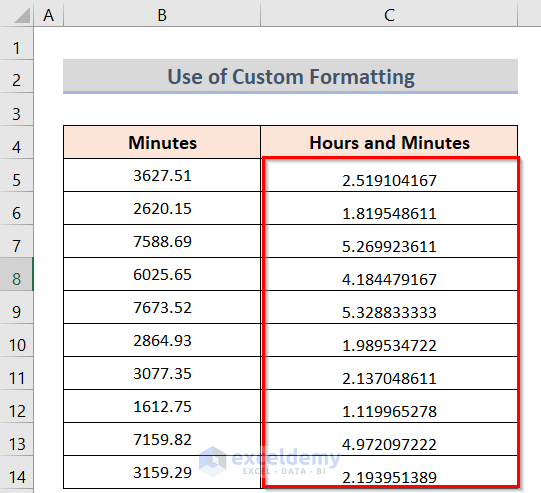
- In addition, you will get the desired result.
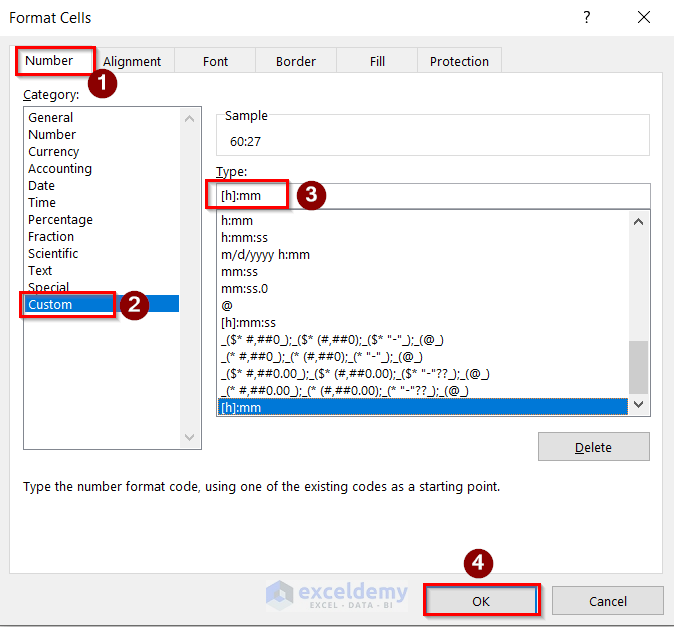
- Press right-clicks on the selected cells, and the Format Cells dialog box will open on the screen.
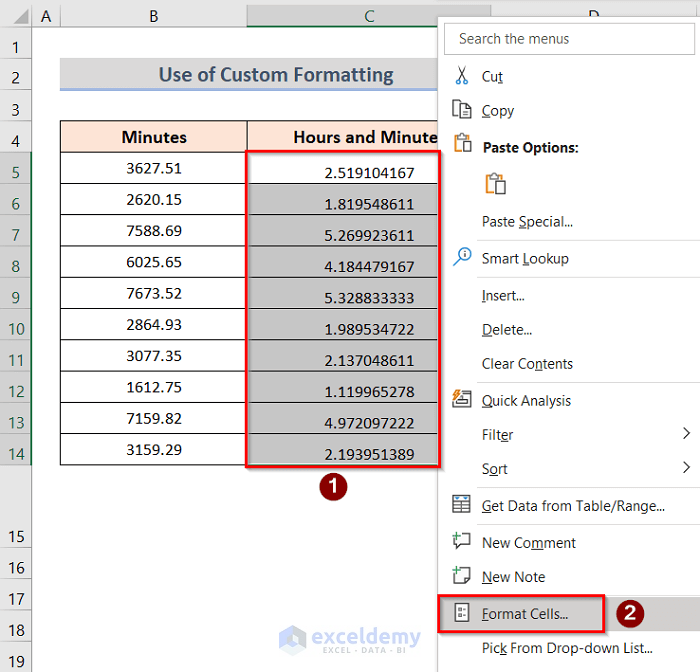
- Go to Number > Custom > Type > [h]:mm > OK.
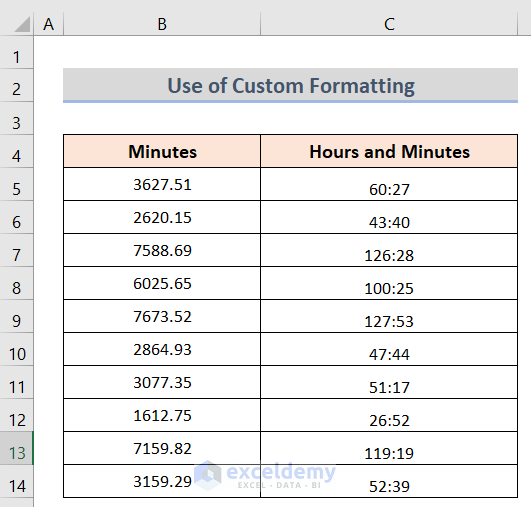
- You will get the desired result.
Things to Remember
- Among all the methods, using the TEXT Function is the easiest to create and most efficient way to use it in all situations.
- If only you don’t want to use any formula, then you can use the Custom Format.
- No matter which method you have used, just learn it well enough so that you can understand its formula and final output.
Download Practice Workbook
Related Articles
- How to Convert Milliseconds to Seconds in Excel
- How to Convert Minutes to Hundredths in Excel
- How to Convert Minutes to Days in Excel
- How to Convert Minutes to Tenths of an Hour in Excel
- How to Convert Seconds to Hours Minutes Seconds in Excel
<< Go Back to Convert Time to Hours | Time Conversion | Date-Time in Excel | Learn Excel
Get FREE Advanced Excel Exercises with Solutions!


Hi There – I don’t think all of the formulas in this article “How to Convert Minutes to Hours and Minutes in Excel: 5 Methods” are working as they should.
The TEXT Method works. Methods 1, 3 and 5 work (at least in your example).
The CONVERT Method returns a decimal result which could as easily be done by taking total number of minutes and dividing by 60. AND – the results that are listed are incorrect – I would assume that the numbers shown in the results column would be the same for all 5 methods, but they are not. If 3627.51 is 60 hours and 27.5 – that should show up in every method. But in CONVERT is comes out as 60.46 and in Method 4 (Quotient and Int) it also comes out to 60.46 in your example.
You probably should fix this because it does not inspire faith in your training.
Hello Diane,
Thank you for your detailed feedback and for going through the methods so carefully. The results you’re seeing are actually consistent in value, but they are presented in different formats, which can understandably cause confusion. Some methods (like TEXT and formatting-based ones) return the result as hours and minutes, while others (such as CONVERT and division/QUOTIENT approaches) return decimal hours.
For example:
• 3627.51 minutes ÷ 60 = 60.46 hours (decimal format)
• The same value expressed differently = 60 hours and ~27.5 minutes
So the difference isn’t in the calculation, but in how the result is displayed.
That said, you make a fair point that the article could present these outputs more consistently or clarify the distinction more explicitly. We’ll take that into account to improve clarity for readers.
Regards,
ExcelDemy