

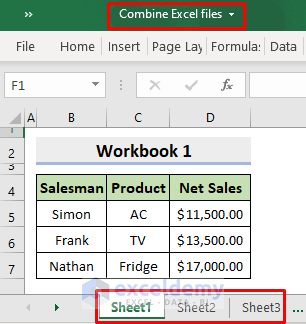
In this example there are three different Excel Files and each of them contain a different Sheet.
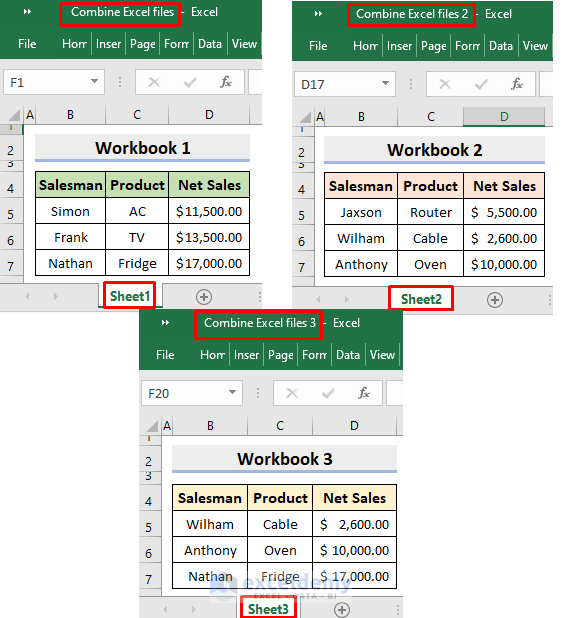
Method 1 – Apply Move or Copy Operation to Combine Multiple Excel Files into One Workbook with Separate Sheets
STEPS:
- Open the second Excel file (Combine Excel files 2).
- Select the sheet (Sheet2) and right-click on the mouse.
- Select Move or Copy in the menu.
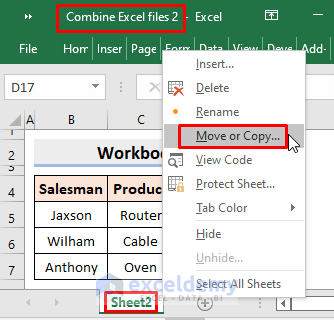
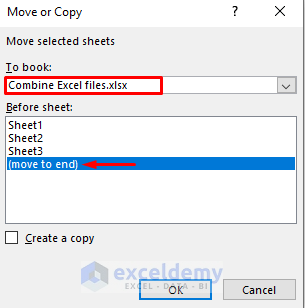
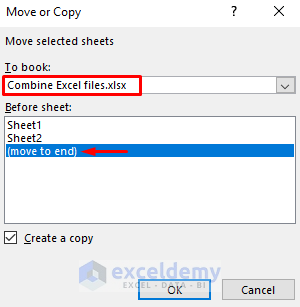
- The Move or Copy dialog box will pop out.
- Select Combine Excel files.xlsx from To book options and select (move to end) in the field Before sheet.
- Press OK.
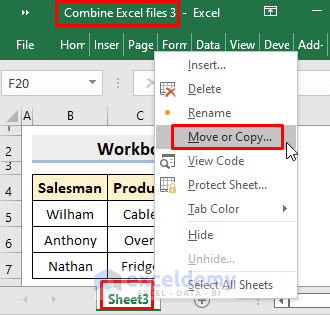
- Open the third Excel file (Combine Excel files 3).
- Select sheet (Sheet3) and right-click on the mouse.
- Select Move or Copy in the menu.
- In the To book field, select Combine Excel files.xlsx, and in the Before sheet, select (move to end).
- Press OK.
- The separate sheets are combined in a single workbook.
Method 2 – Combine Multiple Excel Files Into One Workbook with Paste Link Feature
STEPS:
- Copy cell B2 from Sheet2 in the Combine Excel files 2.
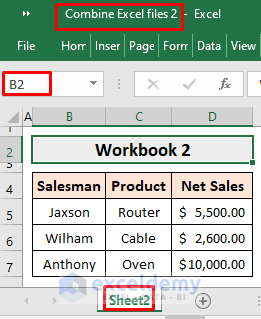
- Go to the destination workbook. In this example, the destination is Combine Excel files.
- Select a cell, B2 here.
- Select Paste Link from the Paste Options.
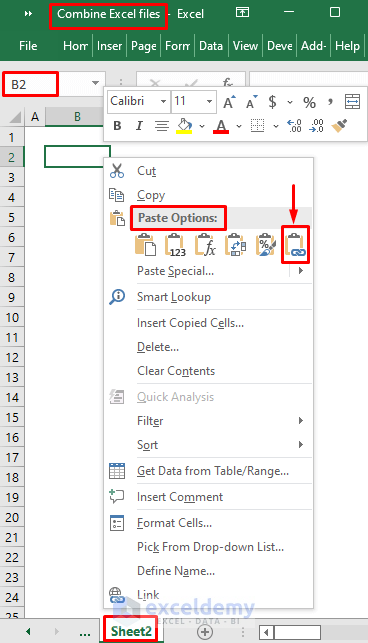
- A formula will be created as below.
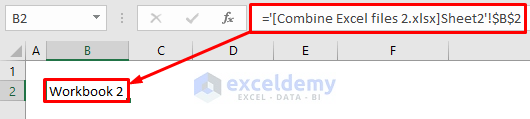
- Remove all the ‘$’ signs present in the formula and use the AutoFill tool to complete the series.
- The source worksheet is returned as below.
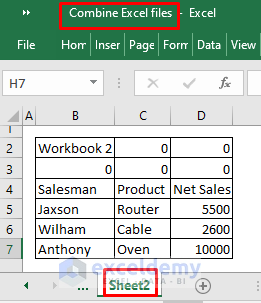
- Repeat the steps for the third Excel file.
- The sheets have been combined in a single workbook.
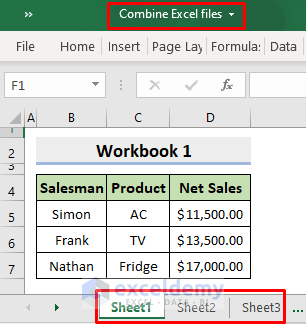
Method 3 – Use Power Query to Combine Multiple Files into One Workbook with Separate Sheets
STEPS:
- Open the first workbook (Combine Excel files).
- Go to Data ➤ Get Data ➤ From File ➤ From Workbook.
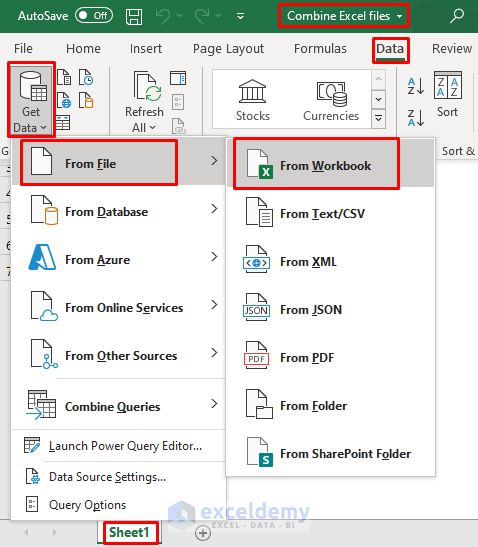
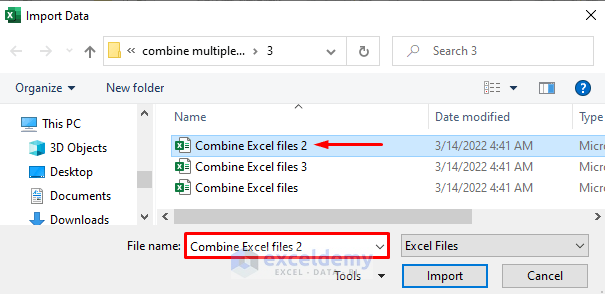
- The Import Data window will pop out.
- Select Combine Excel files 2 and press Import.
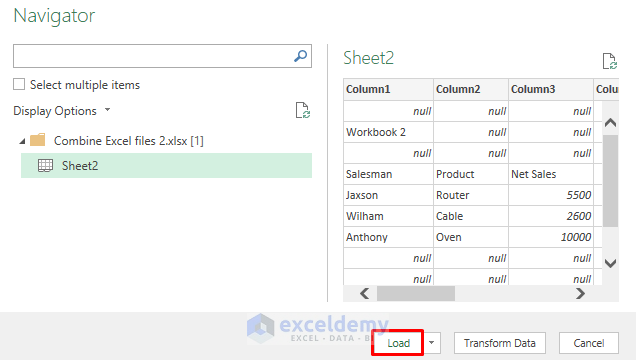
- The Navigator window will pop out.
- Press Load.
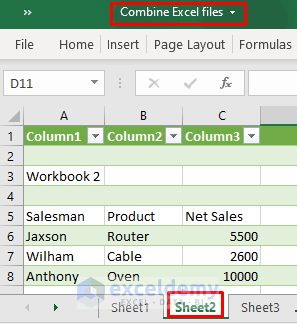
- Sheet2 from the second workbook is added as a Table.
- Repeat the process to get Sheet3 from the third workbook.
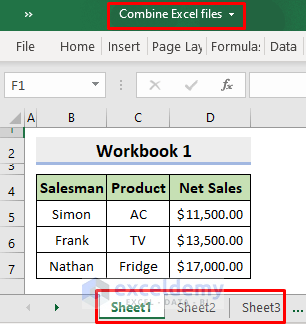
- All three sheets are combined in a single workbook.
Method 4 – Excel VBA to Combine Multiple Files into One Workbook with Separate Sheets
STEPS:
- Open the destination workbook. (Combine Excel files).
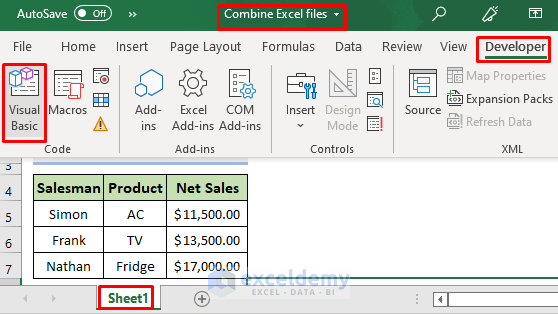
- Select Visual Basic from the Developer tab.
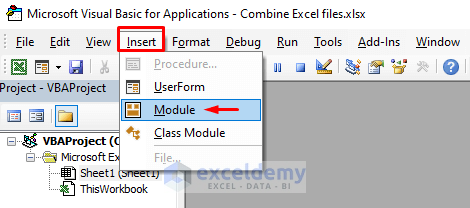
- Select Module in the Insert tab.
- The Module window will pop out.
- Insert the following code.
Sub CombineFiles()
Dim FilesSelected, i As Integer
Dim tempFile As FileDialog
Dim MainBook, sourceBook As Workbook
Dim Sheet As Worksheet
Set MainBook = Application.ActiveWorkbook
Set tempFile = Application.FileDialog(msoFileDialogFilePicker)
tempFile.AllowMultiSelect = True
FilesSelected = tempFile.Show
For i = 1 To tempFile.SelectedItems.Count
Workbooks.Open tempFile.SelectedItems(i)
Set sourceBook = ActiveWorkbook
For Each Sheet In sourceBook.Worksheets
    Sheet.Copy after:=MainBook.Sheets(MainBook.Worksheets.Count)
Next Sheet
    sourceBook.Close
Next i
End Sub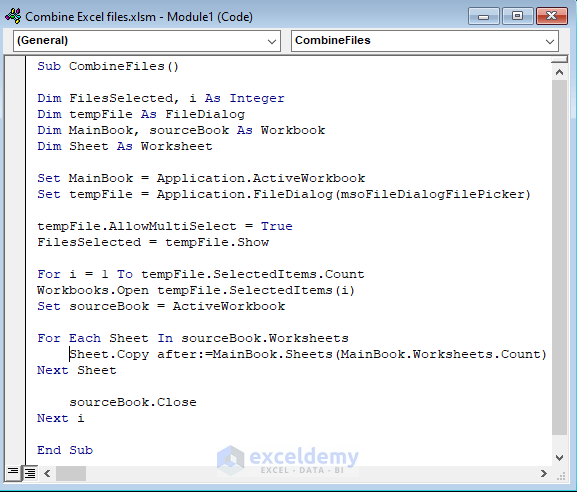
- Close the Visual Basic window.
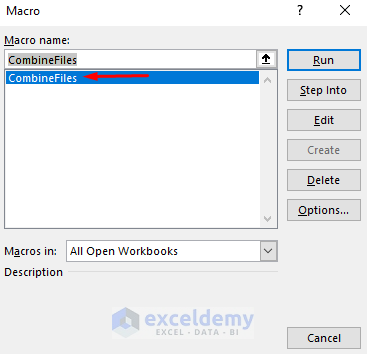
- Under the Developer tab, select Macros.
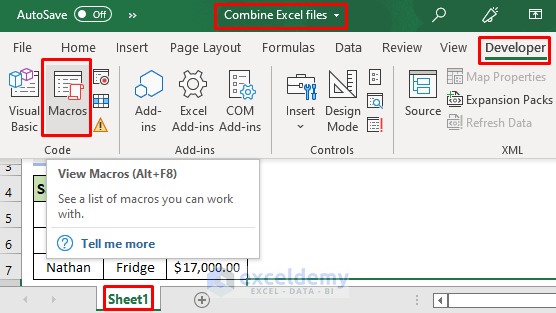
- The Macro dialog box will pop out.
- Select CombineFiles in the Macro name.
- Press Run.
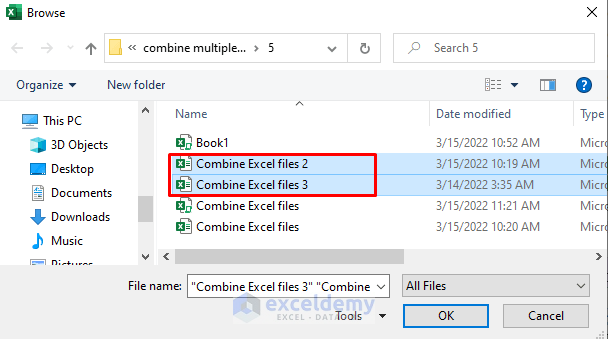
- A Browse window will pop out.
- Select the files you want to combine and press OK.
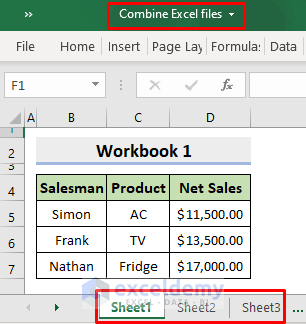
- The sheets have been combined into a single workbook.
Download Practice Workbook
<< Go Back To Merge Excel File | Merge in Excel | Learn Excel
Get FREE Advanced Excel Exercises with Solutions!


I used method 3 to resolve my issue, and it works.
Thanks for the help.
Hello JoJo,
You are most welcome. Thanks for your feedback and appreciation. Glad to hear that method 3 solved your issue. Keep exploring Excel with ExcelDemy!
Regards
ExcelDemy
Hi there, with method 3, do i have to select each workbook and repeat the steps for each file or is there a quicker way. I tried getting data from folder but selecting all the workbook at once but it seems like they are combining my data into one tab instead.
Hello Jonathan,
With Method 3 (using “Get Data from Folder”), Power Query will combine all your files into a single table by default, which puts everything into one sheet. If you want to keep each workbook’s data on a separate sheet, you’d need to load each file individually or modify the query to split them.
Unfortunately, there isn’t a built-in option to automatically load each file into its own separate sheet when importing from a folder.
You’d have to either repeat the process for each file or use VBA or a custom Power Query solution to separate them after loading.
Custom Power Query Solution:
1. Go to Data → Get Data → From File → From Folder.
2. Select the folder containing the files.
3. Click Transform Data.
4. Now in Power Query: You’ll see a table listing all files.
5. Do not click Combine.
6. Right-click the binary link under the Content column >> select Add New Query (click on each cell manually).
7. This opens that file as a new separate query. Rename the query as needed.
8. Repeat this for all files.
Regards
ExcelDemy
Hola, a mi me funcionó el 4to método, Muchas Gracias!! Excelente servicio.
Hello Renzo,
¡Muchas gracias por tu comentario! Nos alegra saber que el cuarto método te funcionó. ¡Apreciamos mucho tu apoyo y tus amables palabras!
Thank you so much for your comment! We’re glad to hear that the fourth method worked for you. We really appreciate your support and kind words!
Regards,
ExcelDemy